
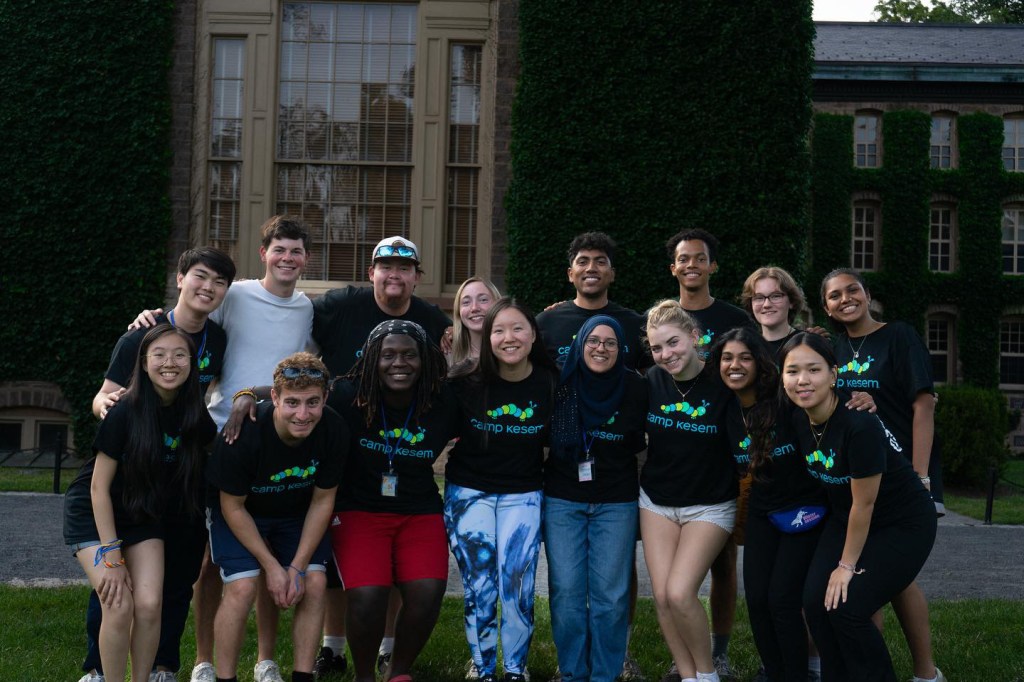
Last week, I had the amazing opportunity to be a counselor at Camp Kesem, a summer camp for children whose parents have been diagnosed with cancer. The main purpose of the camp, from what I saw, was to give the kids a space to be kids amidst the struggles they face in their daily lives. From glow-in-the-dark dance parties to talent shows to scavenger hunts, the camp made me feel as if I was in elementary school again, bringing back my childhood joy. I can’t express enough how much I loved this camp, and I will do my absolute best to become a counselor again in the future.
But this camp wasn’t just a mindless “have fun and be a kid” experience; it really hit home for me on a personal level. There were just genuinely heartbreaking realizations which I never really seriously considered until I was staring at it right in the face.
For example, you know the game where you gather up in a line, and then you take a step forward if you’ve ever done x or y? The purpose of this game is to show a group of people that they are united in their struggles and that other people experience the same hardships. My church played this once at a revival night: the questions they asked were “Take a step forward if you’ve ever felt lonely before” or “Take a step forward if you’ve ever been sad.” Then, basically everyone would take a step forward and the pastor would use this as emotional leverage to explain how this is why we all need Jesus to fill in the holes in our hearts. I’ve played this game multiple times in youth groups before, and so I thought I knew what to expect coming into Kesem.
Except I didn’t.
The questions at Kesem weren’t general emotions like I’ve seen in churches; the questions were “take a step forward if your parents are dead.” And I would see more than half the camp, some 5, 6 year olds taking a step forward. Of course I knew coming in that I would be a counselor for kids who have parents with cancer, but for some reason, it didn’t occur to me that the majority of these kids didn’t have parents at all.
What was even more heartbreaking was the fact that I could actually tell which of the kids didn’t have parents even before we played this game. It was just by watching them interact with other campers, through the group activities we did, and with the conversations I had with them. I had suspicions that something was off since I have had plenty of experience working with kids throughout my 5 years teaching at APC: these kids were different from the ones I worked with despite being the same age. The “take a step forward” game simply explained this observation.
It was then that the purpose of Kesem really struck a chord for me: it’s so important for us to give these kids a space to just be a kid. Some of these campers were forced to grow up fast without their parental figures to guide them. In fact, I was kind of shocked at how some of these campers were more mature than I was despite my counselor status: but it really hurt me to think that the reasoning for that was because they simply had to mature faster.
This was made especially clear during one of the most meaningful conversations I’ve ever had with a camper who went by “Daniel” (fake name. I won’t share his name even though Kesem already gives the kids aliases so they don’t have to reveal their true identity). For those of you who know me, you would know that I can go on for hours discussing philosophy and theology. This is one of the reasons I love being in Manna at Princeton: I get to talk with some of the smartest college students in the world about their faith. But never in a million years would I think I could discuss theology in depth with a kid.
Daniel seriously proved me wrong. After losing his dad, he explained to me that he went through the typical “darn you God” phase, but eventually realized that this position was really immature and he decided to incorporate God back into his life after researching various religions. At first, I didn’t want to probe him any further since I have a tendency to question people’s faiths by poking holes in their lines of reasoning. Here is a child who lost his father to cancer and turned back to Christianity for a sense of security: it would be borderline evil for me to try to “poke holes in his line of reasoning” so I can see where his faith is at.
But I soon realized I had absolutely nothing to worry about. Daniel was not only more mature than I was, but I soon learned he was also more knowledgeable than me when it came to religious doctrine, philosophy, and faith. His faith in God was more grounded than my own by a mile. In our conversation, he ended up teaching me about Islamic doctrine, Enlightenment philosophy, and he defended his Christian beliefs better than anyone I’ve ever spoken to before. Something that I genuinely appreciated was that his faith in God didn’t come from the typical “I was sad so I prayed and met God” like most other Christians, but it was from a methodological look at the facts of each religion and in-depth research into which one was the most compelling. I won’t go too deep into our conversation since this blog post would be like 50 pages long, but just to give you a sense of how well-versed he was, at some point I even threw my best argument against an objective moral value system (his tangible proof of the existence of a monotheistic God) and he explained my rebuttal away so eloquently that I think even the most skeptical atheists would be impressed.
Anyways now I’m ranting too much about theology and will get back to my main point. It should be noted that kids like him should be talking about Brawl stars, Valorant and Baseball. Daniel shouldn’t have to be philosophically analyzing the ontological argument for God’s existence to have assurance that his dad is in a better place.
That hurts. Cancer is truly horrible. But I know that kids like Daniel are going to grow up to be some of the finest, most successful world changers who are going to make their parents smile from above.
I’m going to end this blog post rather abruptly now since I’ve gone on for a while. But the main takeaway is that there are kids out there suffering more than we know. And that is something the rest of us shouldn’t only remember when these kids are right in front of us.

 Jonathan's Place